
Planning to apply for MBBS in Pakistan for the 2026–2027 session and beyond? Discover the latest PMDC admission guidelines, complete Punjab public medical college closing merits, step-by-step registration steps, and use our built-in aggregate calculator to check your admission chances instantly.
Ultimate Guide to MBBS Admissions 2026–2027 in Pakistan: Rules, Punjab Merit Lists, and Aggregate Calculator
Securing a seat in a government medical college in Pakistan is one of the most competitive academic milestones a student can chase. With hundreds of thousands of applicants sitting for the Medical and Dental College Admission Test (MDCAT) every year, staying updated on the latest policies dictated by the Pakistan Medical and Dental Council (PMDC) is absolutely vital.
Whether you are targeting elite institutions like King Edward Medical University (KEMU) or aiming for regional public sector medical colleges, the landscape of medical admissions is evolving. This comprehensive guide breaks down everything you need to know about the MBBS admissions for the 2026–2027 session and onward, structural changes in policies, historical closing merits for Punjab, and how to project your admission probability.
Table of Contents
1. PMDC MBBS Admission Policy 2026 & Onward: What’s New?
The regulatory framework governing medical education in Pakistan focuses heavily on transparency, centralized digitisation, and standardized grading. For the 2026 cycle and subsequent years, PMDC has stabilized several policies that previously fluctuated, giving students a predictable runway for their exam prep.
Centralized Admitting Authorities
Admissions remain decentralized at the provincial level but are centrally standardized. This means that while PMDC sets the baseline criteria, a designated university in each province manages the localized application process, merit compilation, and college allocation:
- Punjab: University of Health Sciences (UHS)
- Sindh: Dow University of Health Sciences (DUHS)
- Khyber Pakhtunkhwa: Khyber Medical University (KMU)
- Balochistan: Bolan University of Medical and Health Sciences (BUMHS)
- Federal Capital & AJK: Shaheed Zulfiqar Ali Bhutto Medical University (SZABMU)
MDCAT Validity & Retake Regulations
A critical update for 2026 and forward-looking sessions is the strict validity rule of the MDCAT score. A single MDCAT score is only valid for one year for public sector admissions. If you took the exam in a previous calendar year and intend to apply for the 2026–2027 cycle, you must retake the MDCAT to clear the competitive threshold of the current cohort.
2. Understanding the Standard PMDC Weightage Formula
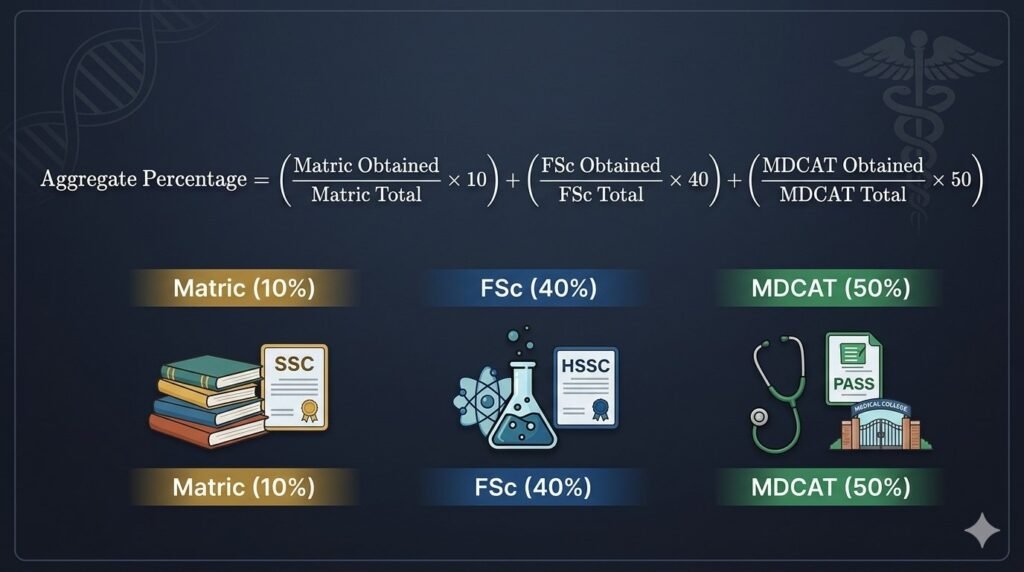
To eliminate discrepancies between different intermediate boards and international systems (like Cambridge O/A-Levels), PMDC enforces a strict weightage matrix. Your position on the provincial merit list is determined entirely by this aggregate percentage.
The standard calculation breakdown is as follows:
- Matriculation / SSC / O-Level Equivalence: 10% of your total aggregate.
- Intermediate / HSSC (Pre-Medical) / A-Level Equivalence: 40% of your total aggregate.
- MDCAT Score: 50% of your total aggregate.
Mandatory Eligibility Thresholds
Even if you possess a phenomenal MDCAT score, you cannot apply for an MBBS seat unless you clear these statutory minimums:
- FSc (Pre-Medical) Margin: A minimum of 60% unadjusted marks in Higher Secondary School Certificate (HSSC) or equivalent foreign qualifications.
- MDCAT Passing Marks: A minimum score of 55% in the MDCAT is mandatory to apply for MBBS (and 50% for BDS).
3. How to Calculate Your Aggregate Score
The mathematical formula used to compute your merit ranking is highly precise, extending up to four decimal places.
PMDC MBBS MERIT CALCULATOR
PMDC Medical Merit Calculator
Calculate your official aggregate percentage for MBBS admissions according to current regulations.
4. Government Medical Colleges in Punjab: Last Year Closing Merits
Punjab represents the most fiercely contested battleground for MBBS seats. Due to the high density of top-achieving students, the closing aggregate for open merit seats hovers exceptionally high.
Reviewing the previous cycle's final closing merits helps you benchmark your performance. Below is the historical open-merit data compiled from the final official selection lists issued by the University of Health Sciences (UHS):
| Rank | Name of Government Medical College | Approximate Final Closing Merit |
|---|---|---|
| 1 | King Edward Medical University (KEMU), Lahore | 94.87% |
| 2 | Allama Iqbal Medical College (AIMC), Lahore | 93.95% |
| 3 | Rawalpindi Medical University (RMU), Rawalpindi | 93.20% |
| 4 | Services Institute of Medical Sciences (SIMS), Lahore | 93.12% |
| 5 | Nishtar Medical University (NMU), Multan | 92.65% |
| 6 | Fatima Jinnah Medical University (FJMU), Lahore (Females Only) | 92.50% |
| 7 | Ameer-ud-Din Medical College (AMC), Lahore | 92.31% |
| 8 | Punjab Medical College (PMC), Faisalabad | 92.10% |
| 9 | Quaid-e-Azam Medical College (QAMC), Bahawalpur | 91.85% |
| 10 | Gujranwala Medical College (GMC), Gujranwala | 91.70% |
| 11 | Sahiwal Medical College (SLMC), Sahiwal | 91.52% |
| 12 | Khawaja Muhammad Safdar Medical College (KMSMC), Sialkot | 91.45% |
| 13 | Sargodha Medical College (SMC), Sargodha | 91.38% |
| 14 | Nawaz Sharif Medical College (NSMC), Gujrat | 91.25% |
| 15 | Sheikh Zayed Medical College (SZMC), Rahim Yar Khan | 91.12% |
| 16 | D.G. Khan Medical College (DGKMC), Dera Ghazi Khan | 91.02% |
Key Takeaway from the Data
To secure any open merit MBBS seat in a public sector institution across Punjab, your targeted aggregate goal must be at least 91.2% or above. If your aggregate dips below 91%, your realistic pathways shift toward private sector medical colleges, reciprocal provincial seats, or specialized quota allocations.
5. Step-by-Step Guide to the Application Process
When admission portals open via your provincial admitting body (such as UHS for Punjab), navigating the platform accurately is vital. A minor clerical error can disqualify your application. Follow this standardized roadmap:
Step 1: Document Synchronization & Attestation
Before creating an online account, ensure you have clean digital scans of the following mandatory documents:
- Matric/SSC Certificate and Detailed Marks Certificate (DMC).
- FSc/HSSC Pre-Medical Certificate and DMC.
- For O/A-Level tracks: IBCC Equivalence Certificates.
- Official MDCAT Result Card.
- Domicile Certificate of the candidate.
- CNIC, Smart Card, or Computerized B-Form of the candidate.
- CNIC of the candidate's parent or legal guardian.
- Recent passport-sized color photographs with a blue or white background.
Step 2: Profile Registration
Create an account on the provincial central portal using a valid email address and phone number. Input your exact academic scores. Double-check that your obtained and total marks perfectly match your transcripts.
Step 3: College Preference Listing (Crucial Stage)
You will be asked to arrange choices in order of preference. Always list colleges in order of actual preference, not your perceived merit limitations. The automated sorting system works downward; it evaluates your highest-ranked choice first. If your aggregate meets that college's threshold, you are locked in; if not, it drops to your second preference. Never place a less-preferred college higher on your list just because you think you won’t clear the cutoff for your dream campus.
Step 4: Processing Fee Deposit
Generate the bank challan from the portal. Pay the non-refundable processing fee at designated bank branches, then re-upload the stamped copy to your portal to activate your application profile.
6. Pro-Tips for Future Medical Aspirants (2027 and Beyond)
If you are a first-year intermediate student or a pre-medical matrix tracker looking down the line at future sessions, recognize that the admission game is won or lost in FSc and MDCAT preparation.
- Maximize Your FSc Foundation: While Matric represents only 10% of the aggregate matrix, FSc controls a massive 40%. Scoring above 1000+ marks in your intermediate exams sets a robust buffer that alleviates severe pressure when sitting for the MDCAT.
- Emphasize Conceptual Learning: The MDCAT syllabus has shifted radically from rote memorization to analytical logic. Focus deeply on mechanisms in Biology, numerical reactions in Chemistry, and core conceptual applications in Physics.
- Keep Alternative Backups Open: Due to the strict demand-supply gap in public medical seats, always cross-register or research allied fields. High-potential fields like Doctor of Physical Therapy (DPT), Doctor of Pharmacy (Pharm-D), Biotechnology, and BS Nursing offer excellent clinical pathways.