
The application of civil servant seniority rules dictates the promotional trajectories and career milestones of public officers across Pakistan. In a major legal developments, the Supreme Court of Pakistan delivered a definitive judgment regarding the implications of training failure on an officer’s service ranking. This landmark case was litigated under Civil Petition for Leave to Appeal No. 670/2024, adjudicated by the apex court on the Date of Hearing: 02.06.2026. The division bench featured Justice Muhammad Ali Mazhar, Justice Musarrat Hilali, and Justice Irfan Saadat Khan. Their comprehensive ruling has resolved a critical ambiguity regarding whether a probationary officer can retain their original batch position if they fail their mandatory initial training modules.
Table of Contents
Factual Background of the Dispute
The litigation originated from an appeal filed by Kamran Khan, an officer appointed as a probationer to the Police Service of Pakistan (PSP) on September 30, 2016. As part of his mandatory terms of service under the Civil Servants Act 1973, he joined the 44th Common Training Program Pakistan (CTP). However, the Civil Service Academy (CSA) reported via official correspondence on April 13, 2017, that the officer failed to complete the 44th CTP satisfactorily due to academic failure, wilful defiance, and general misconduct.
Consequently, the Establishment Division directed him to repeat the initial training cycle alongside the subsequent 45th CTP batch. Following his successful completion of the training with the subsequent batch, the Establishment Division fixed his position in accordance with the civil servant seniority rules, placing him at the bottom of the 45th CTP batch. The respondent challenged this decision, alongside the governing Office Memorandum (O.M.) dated October 22, 2015, which explicitly mandated this re-fixation policy.
Core Legal Questions Before the Apex Court
The Supreme Court of Pakistan had to resolve two primary legal questions:
- Does an administrative Office Memorandum (O.M.) operate in conflict with the statutory framework of the Occupational Groups and Services (Probation, Training and Seniority) Rules, 1990 if it re-delegates an officer’s seniority batch due to training failure?
- Can a probationary civil servant claim vested or inherent rights to historical batch seniority when they fail to clear the mandatory passing out examinations within their original term?
Findings of the Federal Service Tribunal
Prior to the Supreme Court appeal, the Federal Service Tribunal judgement in Appeal No. 328(P)CS/2021 had favored the civil servant. The Tribunal declared the Establishment Division’s O.M. dated 22.10.2015 ultra vires (beyond lawful authority). While the Tribunal accepted that the government possessed the right to make the officer repeat his CTP training, it directed the administration to fix his seniority based on his performance scores inside the 44th CTP, rather than pushing him to the 45th batch. This created a contradictory scenario where an officer could legally belong to one training tier but maintain seniority over colleagues who passed their examinations years prior.
Core Legal Concepts Upheld by the Supreme Court
The Supreme Court reversed the lower tribunal’s findings, highlighting fundamental tenets of public service administration:
1. Seniority is Not an Inherent Right
The apex court explicitly stated that seniority is not a fundamental or inherent right under public service frameworks. Instead, it is a statutory creation that must be strictly calculated and regulated in accordance with the specific text of the legislative rules.
2. The Final Passing Out Requirement
Under Rule 7 of the Occupational Groups and Services Rules 1990, passing the final examination is a non-negotiable prerequisite to establishing formal inter-se seniority. If a civil servant consumes extra time or attempts to clear the mandatory training, they lose all privileges associated with their original entry date.
3. Strict Interpretation of Ultra Vires
The Supreme Court clarified that an administrative policy or O.M. is only ultra vires if it is executed completely shorn of authority or contravenes primary laws. Because the 2015 O.M. completely harmonized with the penalty structures outlines in Rules 6 and 7 of the 1990 Rules, the Federal Service Tribunal erred by striking it down.
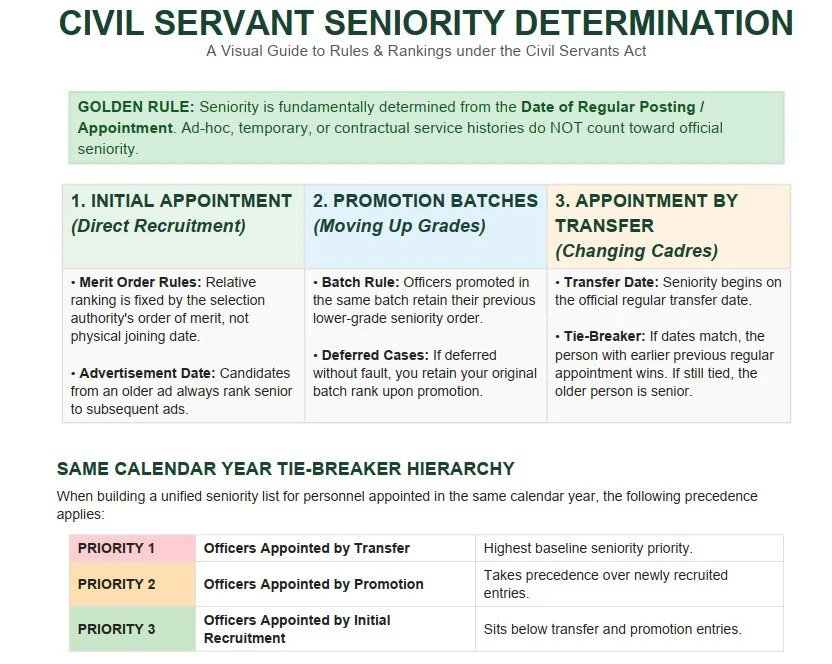
Final Judgement
Consequently, the Supreme Court of Pakistan formally allowed Civil Petition No. 670/2024, converting it into a regular civil appeal. The apex court set aside the previous Federal Service Tribunal judgement and dismissed the officer’s underlying service appeal. The regularized seniority status of the civil servant remains permanently fixed at the bottom of the 45th CTP batch, establishing that grace extended during probation must not be misused to demand undeserved career privileges.
Importance and Practical Implications for Service Law
This ruling brings structural clarity to the civil servant seniority rules applied across federal cadres. It eliminates the risk of administrative back-logs caused by probationary officers claiming historic placement over direct recruits who cleared their requirements on their very first attempt. Additionally, it reinforces the state’s authority to set high standards of professional discipline during early service, confirming that a failure to pass mandatory training brings definitive legal and structural career consequences.
Key Decision Highlights
| Legal Parameter | Federal Service Tribunal View | Supreme Court Final Verdict |
|---|---|---|
| Status of 2015 O.M. | Declared ultra vires and void. | Declared fully valid and harmonious with rules. |
| Seniority Determination | Based on original 44th CTP marks. | Fixed with successful 45th CTP batch. |
| Nature of Seniority | Treated as an alterable, protected right. | Explicitly ruled as a non-inherent, statutory right. |
| Pay Fixation Relief | Unaffected by training performance. | Maintained from original date as a grace benefit. |
Conclusion
Ultimately, the apex court has established that compliance with the civil servant seniority rules requires absolute meritocracy and successful training completion. Public officers cannot exploit administrative leniency to preserve a senior status they failed to earn. Moving forward, all federal appointments under the Civil Servants Act 1973 will remain tethered to actual performance, protecting the institutional integrity of Pakistan’s superior bureaucracy.